
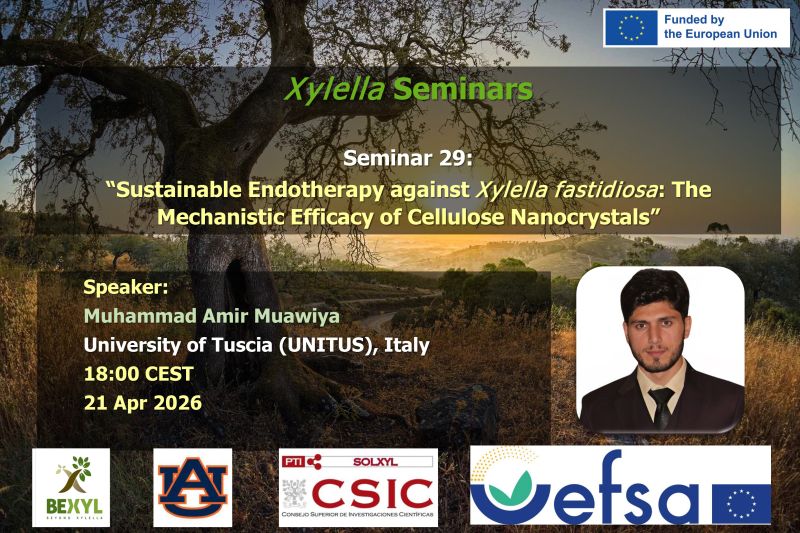
On April 21st, a seminar was held by Dr. Muhammad Amir Muawiya, a doctoral researcher from the University of Tuscia (UNITUS) in Viterbo.
The event was jointly organized by the EU-funded BeXyl project, the EFSA (European Food Safety Authority), and Auburn University. The full video of the seminar is available on the YouTube channel “Soluciones a Xylella fastidiosa.”
Research Focus: Sustainable Endotherapy
The seminar presents the results of innovative research on the use of Cellulose Nanocrystals (CNC) as an endotherapeutic treatment against Xylella fastidiosa. The study focuses on CNCs, a nanomaterial derived from wood processing waste.
The research followed a three-phase approach:
- In Vitro Testing (Laboratory): Evaluating the direct effect on bacterial growth.
- In Vivo Testing (Tobacco model plants): Assessing the efficacy within a living organism.
- Advanced Physiological Analysis: Using non-destructive tools to monitor plant health.
Key Findings from Monitoring:
- Chlorophyll Recovery: Treated plants demonstrated a recovery of their photosynthetic capacity.
- Canopy Integrity: Vegetation indices confirmed that plants treated with CNC maintain a health status similar to that of healthy plants, preventing the canopy collapse typical of Xylella infections.
Conclusions and Future Perspectives
The seminar concluded with an optimistic yet rigorous outlook:
- Cost-effectiveness: CNC endotherapy is potentially more economical than uprooting and replanting (which can cost up to €150 per tree and take a decade to reach full production).
- Sustainability: A zero-residue material derived from renewable resources.
- Next Steps: Field trials are currently underway in Puglia (on olive trees) and in Córdoba (on almond trees) to confirm the treatment’s efficacy under real-world, large-scale conditions.
About the Speaker
Muhammad Amir Muawiya is a Ph.D. researcher (SPVA program) at the Department of Agricultural and Forestry Sciences (DAFNE) of the University of Tuscia. He recently served as a Visiting Doctoral Researcher at the Institute for Sustainable Agriculture (IAS-CSIC) in Córdoba, Spain.
His doctoral program focuses on the circular plant protection of Mediterranean crops against biotic and abiotic stresses. His research specifically targets vascular bacterial pathogens, primarily focusing on combating Xylella fastidiosa.
To achieve this, Muawiya investigates the efficacy of bio-based nanotechnologies and precision endotherapy through:
- Comprehensive in vitro and in vivo approaches.
- Advanced molecular diagnostics.
- Non-destructive hyperspectral phenotyping to evaluate pathogen containment and the physiological recovery of the host plant.
Previous Experience
Prior to his Ph.D., he served for three years as a Scientific Officer at the Pakistan Agricultural Research Council (PARC). In this role, he specialized in bio-saline horticulture and climate adaptability, promoting the cultivation of olives and other high-value horticultural and medicinal crops in arid, high-stress environments.