
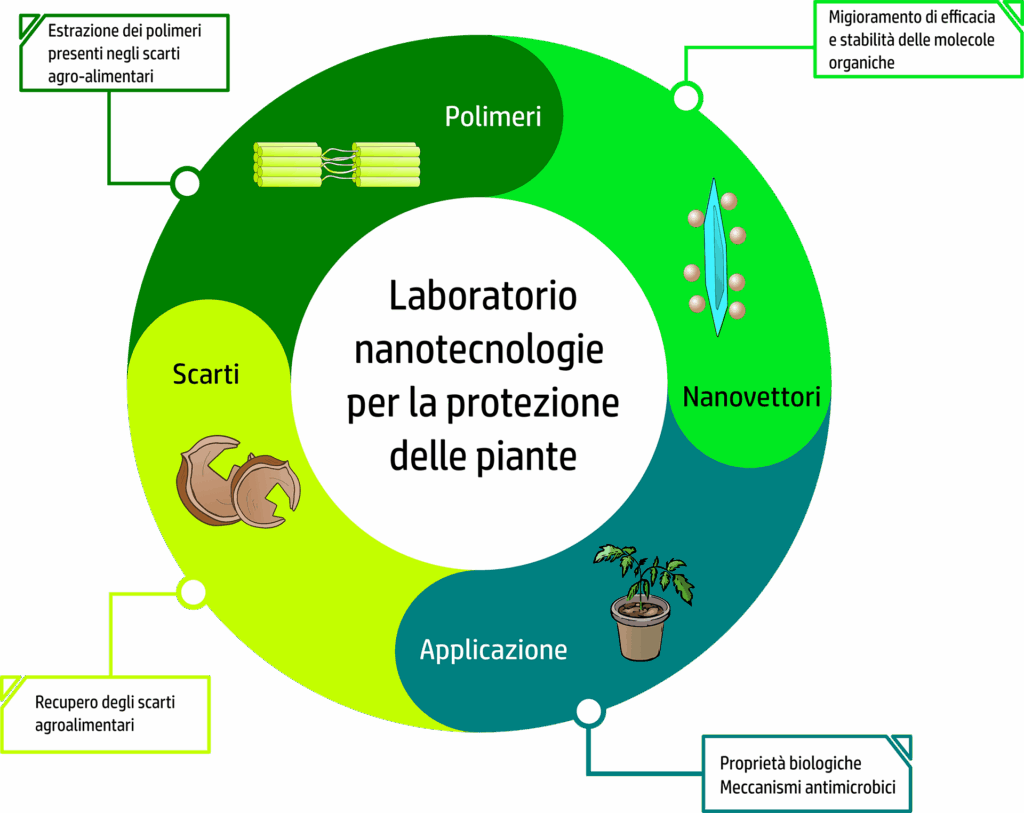
For several years, the research group led by Prof. Balestra has been working on developing and studying the application of nanotechnology in plant pathology, with the aim of identifying innovative strategies for crop protection based on the use of green nanomaterials and nanoformulations.
These are produced by recycling waste from various agri-food sectors, in line with a circular economy approach.
Research Areas
The research areas being pursued include:
- the extraction of organic biopolymers (cellulose, lignin, chitosan) from waste generated by various agri-food sectors;
- their characterisation and synthesis at the nanoscale (cellulose nanocrystals, lignin and chitosan nanoparticles);
- their activity both as carriers of organic molecules and in directly exerting antimicrobial activity;
- the efficacy, stability and release kinetics of the nanocomposites at the parenchymal and systemic levels;
- the characterisation of the biological properties of nanomaterials in terms of antimicrobial mechanisms (against various pathogens) and biostimulant activity, using in vitro and in planta microbiological assays (assays for efficacy, biostimulation and priming of defences)
Fully Equipped Laboratories and State-of-the-Art Technology
The Research Group has access to laboratories equipped with:
- growth chambers;
- biological safety cabinets;
- freeze-dryers;
- ultrasonicators;
- state-of-the-art technological equipment for the synthesis and study of nanomaterials;
- climate-controlled greenhouses.
Partnerships
The Research Group works in collaboration with the University’s Large Equipment Centre for electron microscopy applications (SEM; confocal TEM, etc.). It also collaborates with numerous public bodies, professional firms and private companies to develop educational activities (work placements, final projects, degree theses) and to provide training for the agro-industrial sector.