
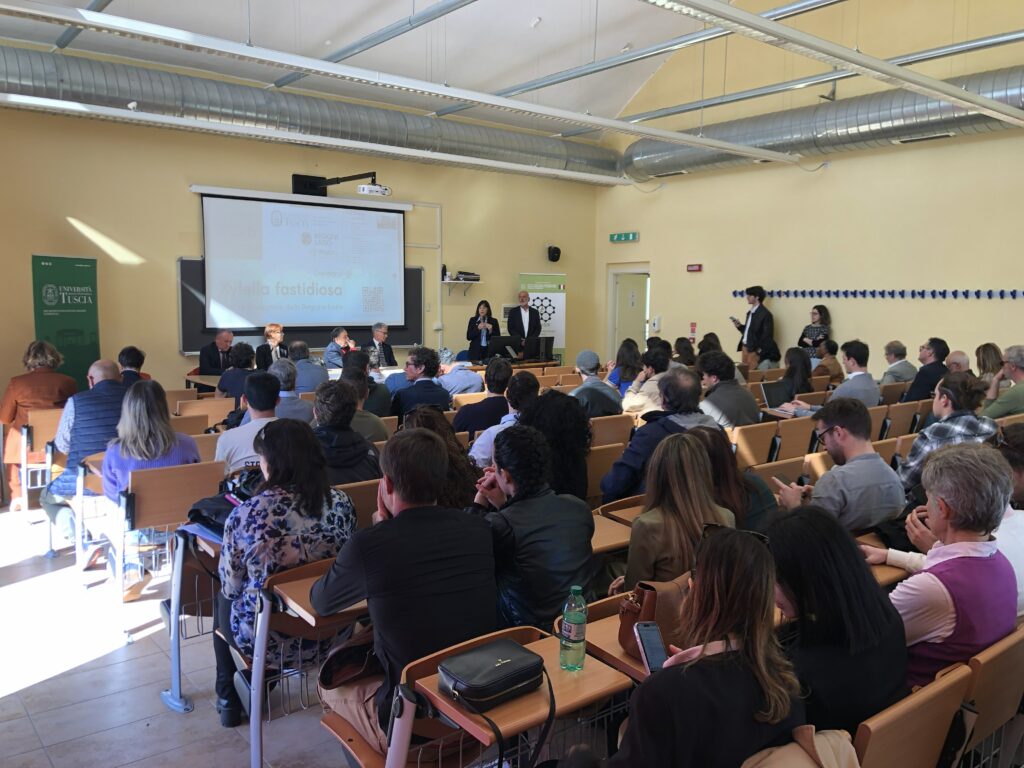
With over one hundred participants, the summit held on April 16th was a resounding success. The event featured opening remarks by the Rector, Prof. Laureti, and the Director of the DAFNE Department, Prof. Severini, followed by contributions from the President of the Agriculture and Environment Commission, Zelli Menegalli, and the Hon. Sabatini.
Throughout the meeting, the Lazio Region, represented by Dr. Bianchi of the Regional Phytosanitary Service, the PhyDia laboratory, and the Plant Pathology and Nanotechnology for Plant Protection Team (DAFNE Department, University of Tuscia), reaffirmed a unified commitment. This “team effort” is dedicated to actively addressing the Xylella challenge alongside producers of the Tuscia region’s high-quality supply chains, specifically almond and olive.
A National Expert’s Perspective
Coordinated by Prof. Balestra, the meeting saw the participation of the Order of Agronomists and Foresters, trade organizations, and numerous university students. The centerpiece of the event was a masterly presentation by Dr. Boscia, former Director of the Institute for Plant Protection (CNR, Bari). Dr. Boscia is Italy’s leading expert on the bacterial infection that has severely impacted Apulian olive growing since 2013.
While Xylella fastidiosa subsp. pauca (responsible for Olive Quick Decline Syndrome) is currently found exclusively in Puglia, other populations have been identified elsewhere. Among these is Xylella fastidiosa subsp. multiplex, which was detected in 2021 on a single wild almond tree in the Viterbo area. This discovery has caused concern, particularly among local almond growers.
Current Situation and Regulatory Challenges
The summit clarified that the situation in Lazio is constantly monitored, does not currently affect olive cultivation, and remains strictly limited regarding almond trees.
However, current European Union regulations are stringent, mandating:
- The eradication of any plants testing positive for Xf subsp. multiplex.
- The removal of all host plants within a 50-meter radius of the infected tree.
Towards Scientific Evidence and Policy Change
In June, the European Conference on Xylella fastidiosa, organized by the EFSA (European Food Safety Authority), will be held in Bari for the first time. On this occasion, the DAFNE research group, in collaboration with the Lazio Region’s monitoring and analysis services, intends to present scientific evidence arguing for a different management approach in the Viterbo area. The goal is to protect excellence-driven supply chains, starting with the almond sector, from disproportionate eradication measures.
The meeting concluded with a constructive dialogue among all stakeholders and a commitment to hold further updates to disseminate research results and advocate for favorable changes in European phytosanitary legislation.
The event was also documented by the local news outlet Etruria News.
24/04/2026